ITANAGAR, Jan 22: Prime Minister Narendra Modi took over G20 presidency from Indonesian President Joko Widodo during G20 summit in Bali on December 1 last with its theme “One Earth, One Family, One Future” and its mandate emphasizes “Lifestyle for Environment” for a coherent agenda of sustainable development, climate action and climate justice.
This philosophy gives Indian Presidency immense opportunities for building consensus in a fractured world. As part of G20 process in India, the Think-tank (T20) discourse by bringing together T20 Task Force members, subject experts, policymakers, diplomats, international organizations, private sector, foundations and the civil society.
Thus, Ministry of External Affairs (MoEA) had identified eight NE universities, namely Rajiv Gandhi University (RGU); IIT, Guwhati; Dibrugarh University, Assam; Manipur University, Imphal; North Eastern Hill University, Meghalaya; Mizoram University, Aizawl; St. Joseph University, Nagaland and Tripura University, Agartala as knowledge partners to coordinate G20 university connect programmes. Moreover, North Eastern Training, Research and Advocacy (NETRA) Foundation was formed to represent eight NE states, according to a NETRA release.
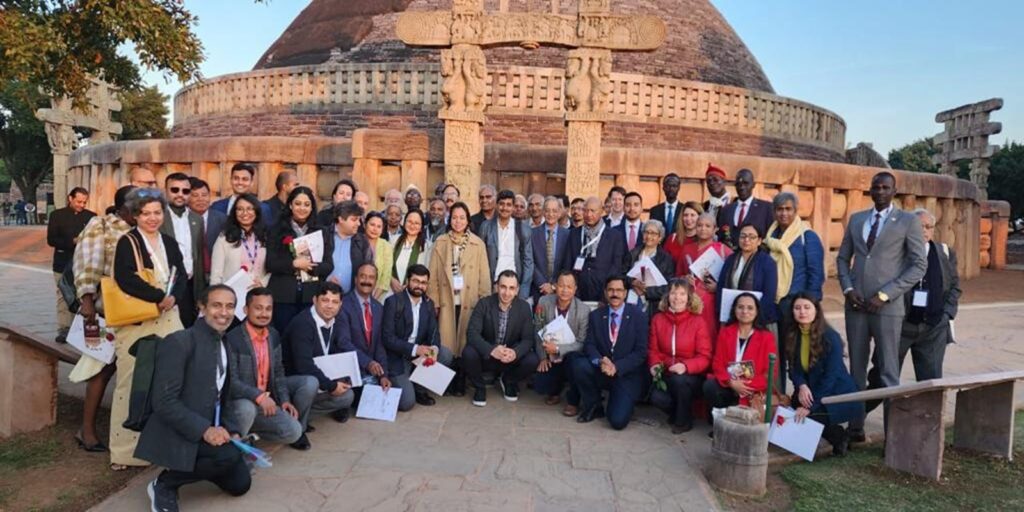
An 11-member NETRA) Foundation team representing eight NE states took part in two-day special T20 conference on ‘Global Governance with LiFE, values and wellbeing: Fostering cooperation in framework, finance and technology’ on January 16-17 last at Bhopal’s Kushabhau Thakre International Convention Centre in Madhya Pradesh.
Research and Information System for Developing Countries (RIS) in collaboration with T20, U20, Madhya Pradesh Govt, Atal Bihari Vajpayee Institute of Good Governance and Policy Analysis (AIGGPA), United Nations International Children’s Emergency Fund (UNICEF), Global Development Centre (GDC) of RIS, Bill & Melinda Gates Foundation (BMGF) organised the event where around 400 participants from 43 countries took part.
Madhya Pradesh Chief Minister Shivraj Singh Chouhan inaugurated the event, RIS Director General/AIGGPA vice chairman and MP Rajya NITI Aayog member Prof Sachin Chaturvedi gave opening remarks while G-20 chief coordinator Harsh Vardhan Shringla, Indonesia Deputy Minister of Political Affairs, Law, Security & Defense, Ministry of National Development Planning/Bappenas Dr. Slamet Soedarsono and NITI Aayog vice chairperson Suman Bery gave special remarks.
NETRA Foundation representatives were Prof Kesang Degi, education department, Rajiv Gandhi University, Arunachal Pradesh; Prof. Polly Vauquline, women’s studies department, Gauhati University, Assam; Prof. Durga Prasad Chetri, political science department, Sikkim University; assistant Prof Dr. N. Surjitkumar, political science department, Indira Gandhi national Tribal University, Manipur; Ivyreen Warjri, assistant director (good governance), Meghalaya Administrative Training Institute; Prof. Lalnilawma, HoD (extension education & rural development, Mizoram University; assistant Prof Dr. Moameren Pongen, political science department, St. Joseph University, Nagaland; Dr. Jayanta Choudhury, assistant Prof & head in-charge, rural studies department, Tripura University; Prof. Subhrabaran Das, economics department, Tripura University; associate Prof Dr. Harsh Chaturvedi, School of Energy Sciences and Engineering, IIT, Guwahati and Garen Warjri Panor, news editor, Meghalaya Legislative Assembly channel.
While highlighting NETRA Foundation activities, especially on localisation of sustainable development goals (SDGs) in NE during an interactive session with the delegates, its secretary general Dr. Jayanta Choudhury stressed on importance of capacity building of various stakeholders and strengthening existing local institutes. He also called for collaboration of various agencies and institutes at different levels for NE development.
Prof. Subhrabaran Das highlighted different strengths and weaknesses of NE while Prof. Polly Vauquline, as a panellist of a session on ‘Women and youth led development’ raised important issues of gender inequality in the country, gender based violence and need to generate data on women. It is important to incorporate gender perspectives and look through gender lenses into every task that India intend to take up during G20 Presidency, she said.
Warjri, as a panelist of a session on ‘One health, wellness and traditional medicine’, said that traditional medicine is knowledge developed over generations. But, there are issues with certification and registration of practitioners in the country. The panel mentioned that scientific research and trials need to be documented as an important criterion for registration and certification to ensure knowledge of traditional medicine is passed on to future generations.
Dr Harsh Chaturvedi, as a panelist of a session on ‘Green energy and logistics’, stressed on collaborative mechanism for joint technology development, IP (internet protocol) sharing for technologically viable development, economically feasible and ecologically responsible methods to implement SDGs. He also suggested joint programs of capacity building connecting higher education institutes with grassroots, database development and sharing of best practices.
Ambassador S. T. Devare, also RIS chairman, gave the valedictory address before the Bhopal Declaration announced, the release added.